
Hard water is not going to destroy your hot water system overnight, but in West Lakes it does speed up the scale that builds inside the tank. Adelaide water hardness sits at the harder end for an Australian capital, and the western suburbs draw the highest of the five Adelaide metropolitan suburb systems SA Water names.
I have serviced storage tanks across the western suburbs for close to a decade at Exceed Plumbing & Air Conditioning, and scale is the slow problem behind most of what owners describe as a system going off. This guide covers how hard the local water really is, what deposit does inside a tank, the warning signs, and the tank and anode choices that change the outcome.
How Hard West Lakes Water Actually Is
West Lakes water measures 118 milligrams per litre as calcium carbonate, the highest of the five Adelaide metropolitan suburb systems SA Water names, comfortably inside the national drinking water guideline:
According to SA Water, testing for the 12 months ending 31 July 2026 puts the western metro Adelaide suburbs system at 118 mg/L as calcium carbonate. West Lakes sits in that system.
The other four Adelaide suburb systems measure lower: eastern 113 mg/L, central 112, northern 111 and southern 108.
Two systems in SA Water’s wider metropolitan region run harder again. Myponga metro reaches 140 mg/L supplying outer southern Adelaide, and the Barossa system 137 mg/L supplying Gawler and surrounds. Neither supplies the western suburbs.
That figure only means something next to the guideline it sits against. The NHMRC’s Australian Drinking Water Guidelines state that “to minimise undesirable build-up of scale in hot water systems, total hardness (as calcium carbonate) in drinking water should not exceed 200 mg/L”.
The same guidelines classify 60 to 200 mg/L as “good quality”, below 60 as “soft but possibly corrosive”, 200 to 500 as “increasing scaling problems” and above 500 as “severe scaling”.
So every system in SA Water’s metropolitan region, from Anstey Hill at 93 mg/L up to Myponga at 140, sits inside that good quality band. The water here is hard for Australia and fully compliant, which makes scale a maintenance question rather than a water quality failure.
What Scale Does Inside a Hot Water System
A tank that once ran three showers back to back and now struggles is usually already carrying scale on its element, because deposit forms fastest where the water is hottest:
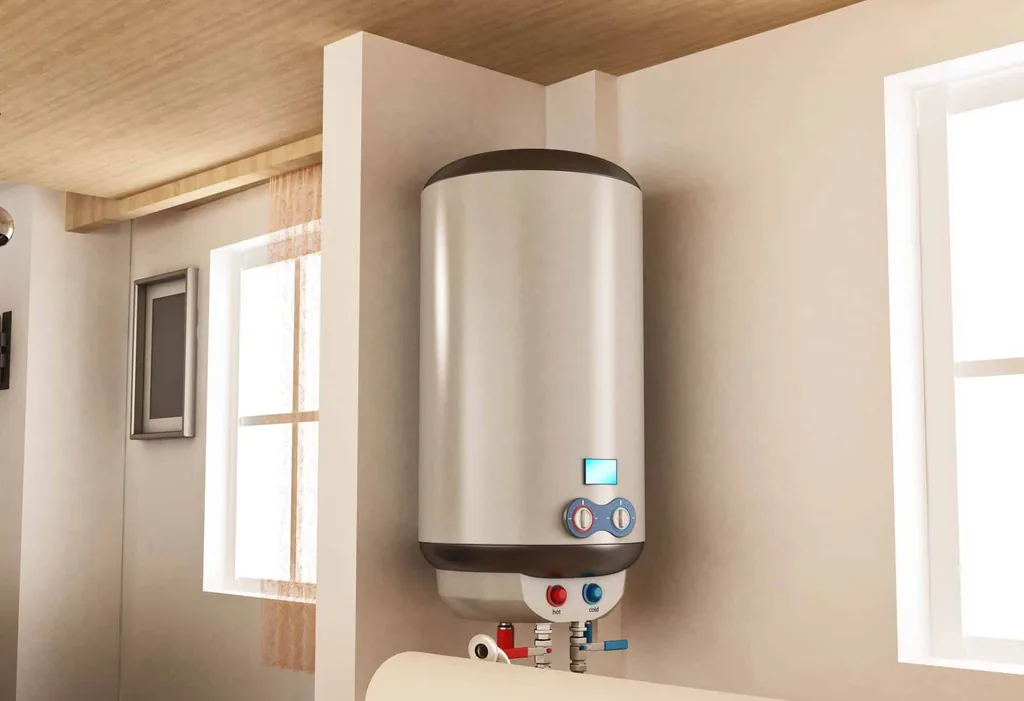
In a storage system, the hottest surfaces are the heating element and the base of the cylinder. Both collect deposit long before anything shows up at a tap.
According to the NHMRC, total hardness above 200 mg/L “may lead to excessive scaling of pipes and fittings, and cause blockage of safety relief valves in hot water systems”.
West Lakes sits at 118 mg/L, comfortably under that threshold, so nothing in the local supply points to imminent failure. What it does mean is steady accumulation over years rather than a tank that stays clean.
You usually notice it somewhere else first. The NHMRC also notes that “hard water requires more soap than soft water to obtain a lather”, which is why kettles and shower screens show the mineral before the hot water system does.
Left alone, that build-up is what turns a routine service into a hot water system repair. The system gives you plenty of warning first.
More: Why Is My Hot Water Running Out Quickly? An Expert Explains
Signs Your System Is Scaling Up
Scale rarely announces itself with a leak, so it shows up instead as heat, noise and volume changes, and these are the signs I hear described most often on callouts:
- Longer reheat times. Scale on the element works like insulation between it and the water. The system still heats but takes longer to recover after two showers.
- Rumbling or kettling from the tank. Deposit on the tank base traps water that boils underneath it. Owners describe it as a kettle noise or a low rumble.
- Less hot water than you used to get. Sediment takes up volume at the bottom of the cylinder, so usable hot water shrinks. A shower running cold early is worth checking.
- White build-up on tapware and shower screens. Customers call it calcium build-up on the shower glass. It is the same mineral load SA Water measures at 118 mg/L, heading into your tank.
- A relief valve that weeps constantly. Temperature and pressure relief valves are meant to discharge, but mineral on the seat stops clean seating.
- Kettles and dishwashers scaling fast. One Adelaide reviewer on ProductReview.com.au described the local supply as hard water with high calcium content. Appliances scale first because they cycle more often.
Scale Symptoms and What They Point To
Most of what people notice at home traces back to a handful of causes, so match the symptom you have to what it usually means and the sensible next step:
| What you notice | What it usually points to | What to do next |
| Hot water slow to recover | Scale coating the heating element | Book a service and element check |
| Rumbling while the tank heats | Sediment sitting on the tank base | Have the cylinder inspected |
| Less hot water than before | Sediment taking up tank volume | Have the tank capacity assessed |
| Relief valve weeping constantly | Mineral on the valve seat | Have the valve tested or replaced |
| White crust on tapware | Dissolved calcium, well under the 200 mg/L guideline | Normal locally, check the anode |
More: Why Is My Hot Water Inconsistent? Causes and Fixes
Why Your Tank Type and Anode Matter
The most consequential hard water decision you will make is not a filter or a softener, it is which type of tank goes in when the old one is replaced:
Glass-Lined Tanks and Anodes
Most electric storage hot water systems use a steel tank with a glass enamel lining, protected by a sacrificial anode. According to the Australian Government’s YourHome, the Australian Government’s housing guide, that anode “needs to be replaced every few years”, and in hard water areas glass-lined tanks “may require a different type of sacrificial anode”.
Stainless Steel in Hard Water
Stainless steel cylinders are the premium option and carry no sacrificial anode at all. YourHome is direct about where they belong: “In hard water areas, where the water has a high concentration of dissolved minerals, stainless steel tanks are not suitable.” West Lakes is a hard water area by any Australian measure.
What the Warranty Ranges Tell You
YourHome puts typical tank warranties at 5 to 10 years for glass-lined steel and 10 to 15 years for stainless steel. That longer range is not a reason to pick stainless here, because a warranty describes the product rather than your supply. YourHome says manufacturers “can provide guidance on which products are suitable for your area”, so ask them before you commit.
What Hard Water Means for Your Warranty
Hard water can affect a hot water system warranty, though not in the way most pages online suggest, and the manufacturer’s actual wording is worth reading closely before you buy:
According to Rheem Australia, its domestic warranty terms state the warranty “may not apply if the water heater is connected to a water supply which has a Total Dissolved Solids content >2500mg/L; is scaling with a Saturation Index >+0.8, or; is corrosive with a Saturation Index <-1.0”.
Read the units carefully, because this is where most articles on the subject go wrong. Those thresholds are Total Dissolved Solids and Saturation Index, not hardness.
Hardness is only one input into the Saturation Index. A homeowner cannot read their warranty risk off a hardness figure alone, and neither can a plumber who quotes one at them.
What it does change is the conversation to have before you buy. Ask the manufacturer or your installer whether the model suits your supply, then keep the service records.
A tank that fails early with no service history behind it is a much harder warranty claim than one with a documented anode change.
How to Protect a Hot Water System in Hard Water
Protecting a hot water system in West Lakes water at 118 mg/L comes down to three practical habits, none of which means buying equipment before you know you need it:
Have the Anode Checked
The sacrificial anode is consumed in service, and YourHome states it “needs to be replaced every few years”. Ask for it to be pulled and inspected at your next service rather than guessing at its condition. In a hard water area, also ask whether the anode type fitted is the right one for the supply.
Match the Tank to the Water
When the unit is due for replacement, choose between tank types on water chemistry, not on warranty length alone. Stainless steel is ruled out here on YourHome’s advice, which leaves a correctly specified glass-lined tank or electric heat pump systems as the practical options.
Service It and Test the Valve
The NHMRC links total hardness above 200 mg/L to blocked safety relief valves, so the valve is worth testing at every service on hot water systems of any age. Regular servicing also builds the documented history that a warranty claim depends on, and it catches a scaled element while it is still just a service call.
More: Why Is My Hot Water System Leaking? All You Need To Know
Adelaide Suburbs We Service
Our licensed plumbers service, repair and replace hot water systems right across metropolitan Adelaide, from scaled elements to failed tanks and heat pump upgrades, in the following suburbs and beyond:
West Lakes, Fulham Gardens, West Beach, Salisbury, Mawson Lakes, Morphett Vale, Goodwood, Linden Park, Modbury, Prospect, Elizabeth, Golden Grove, Happy Valley, Magill, Burnside, Mitcham and Pooraka.
Get Your West Lakes Hot Water System Checked
If the tank rumbles or the hot water runs short, call Exceed Plumbing & Air Conditioning on 0456 461 354. Our licensed team services hot water across West Lakes and Adelaide:
- Within-the-hour response, 24/7
- Fixed upfront pricing, no hidden costs
- Fully licensed and insured (Licence #333997)
- Lifetime Labour Warranty on workmanship
Frequently Asked Questions
Is Adelaide’s water hard?
Yes, by Australian standards. SA Water’s metropolitan systems run between 93 and 140 mg/L as calcium carbonate, all of them inside the NHMRC “good quality” band of 60 to 200 mg/L.
How hard is the water in West Lakes?
West Lakes measures 118 mg/L as calcium carbonate, based on SA Water testing for the 12 months ending 31 July 2026. That is the highest of the five Adelaide metropolitan suburb systems.
Does hard water damage a hot water system?
It accelerates scale on the heating element and tank base rather than causing sudden failure. At West Lakes levels the effect builds gradually, so servicing and the correct anode matter most.
Do I need a water softener in Adelaide?
Not on hardness grounds alone. Every Adelaide metropolitan supply sits inside the NHMRC good quality band, so start with servicing, anode checks and correct tank selection first.
How often should a sacrificial anode be replaced?
YourHome, the Australian Government’s housing guide, states a sacrificial anode “needs to be replaced every few years”. Have it inspected at each service rather than working to a fixed calendar date.
Does Exceed Plumbing & Air Conditioning service hot water systems in West Lakes?
Yes. Exceed Plumbing & Air Conditioning services, repairs and replaces hot water systems across West Lakes and the wider Adelaide area, with 24/7 availability and fixed upfront pricing before work starts.